Check back soon
Once posts are published, you’ll see them here.


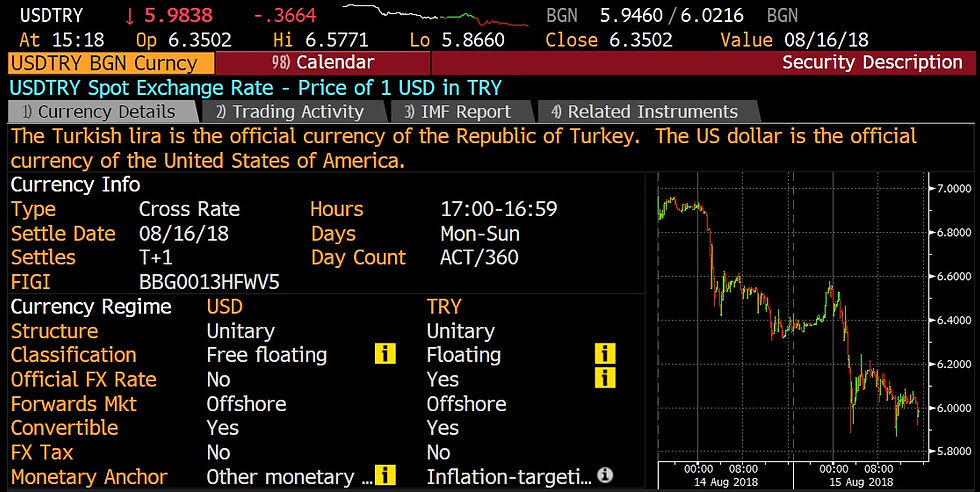
Turkey has been in the headlines of late as the next financial crisis. The Turkish Lira has dropped against the US dollar almost 45% to date and this is driving concerns of contagion throughout Europe. According to data from the Bank for International Settlements (BIS), Spanish banks are exposed to Turkish debt to the tune of $83.3 billion, French banks hold $38.4 billion and Italian banks have $17 billion.
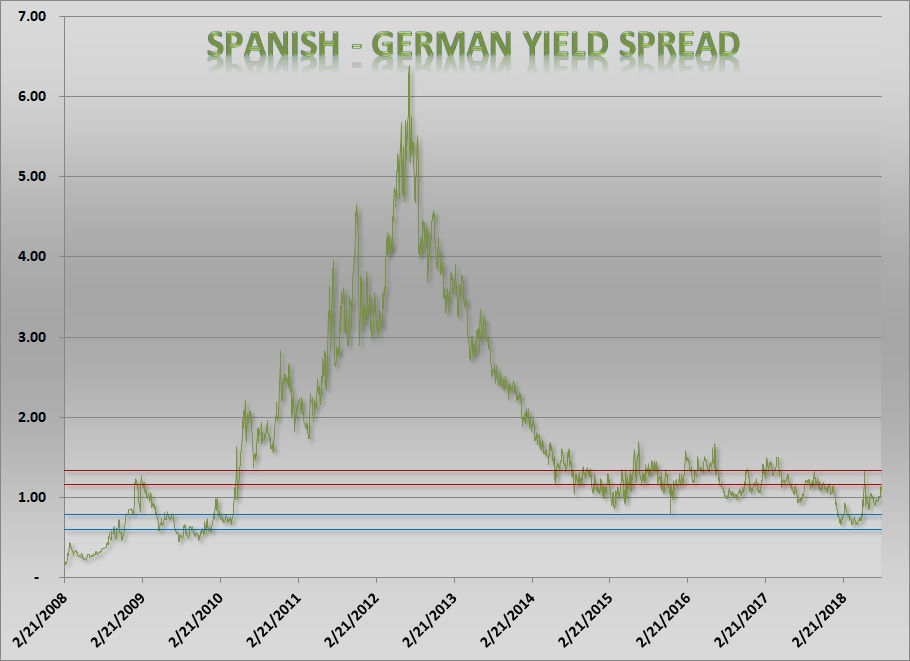
While Turkey’s economy is quite small (roughly the size of Illinois) many fear this situation could spread to the larger economies throughout Europe and the world. Looking at the rate of change in the 10-year yields for the European countries most exposed to Turkish debt, there seems to be little fear in the markets yet. The exception is Italy, but the movement of the yield has been more a function of geopolitical events than the potential Turkish banking crisis (see our blog post Euro-Crisis).

Relative to German yields, the differential is slightly elevated but not within the region of past banking turbulence.

How they got to this point
So, let’s assume we will avoid a complete global banking meltdown and the economic hardship remains contained within Turkey. What happened to lead up to this point?
Turkey was one of the fastest growing emerging economies last year and into 1Q18. This growth was fueled through debt financing as many Turkish companies borrowed heavily to participate in the economic boom. Turkey’s growth in GDP has hovered between 5% to 7% year-over-year for almost the past ten years. This is especially concerning due to Turkey’s low domestic savings and the need to borrow money outside the country. External debt has reached just north of 53% of GDP in 2017.

This in turn has sparked higher inflation with the latest reading of 15.9% in July, the highest level since 2003. Experts forecast that inflation will remain elevated as higher oil and consumer goods prices have yet to be fully recognized throughout their economy.

All this while the Turkish Lira collapses against the US Dollar and the Euro.

This problem has been exacerbated through several policy mistakes in our opinion. Despite runaway inflation, the Central Bank of the Republic of Turkey have dragged their heels as it relates to raising interest rates to try and stabilize prices. The Central Bank has also lost credibility in the eyes of many market participants by providing a muted verbal response towards battling inflation and even failed to raise rates during their last meeting, leaving many to speculate that it was a politically motivated more to satisfy Recep Tayyip Erdogan. Erdogan has prided himself as a pro-growth President leading into re-election earlier this year and believes higher interest rates are evil.
Additionally, he is going toe-to-toe with President Trump on trade policy and appears to be declaring “economic war” on the United States by taxing imports and boycotting American products and the US Dollar. In turn, President Trump drop-kicked the Turkish Lira by tweeting we was going to double all steel and aluminum tariffs imposed on Turkey’s exports. We have written in the past about our negative views on the Administrations trade policy (see Thoughts on Trade Policy) and we also believe it to be foolish to kick a fellow NATO member while they are down, especially when Russian and Iranian ties with Turkey have been warm and fuzzy. This seems like a bit of a knee-jerk reaction by President Trump placating to the Evangelical base demanding the release a Protestant pastor named Andrew Brunson that is being held in Turkey under house-arrest for his alleged contribution to the coup attempt back in 2016. Mid-term elections are coming and this could be a way to secure votes.
The financial crisis concerns start to mount as the Lira continues its descent and makes it more difficult to payback external lenders. A significant amount of debt to be paid back is relatively short-term. According to Bloomberg research about $118 billion or 14% of GDP is maturing in less than a year. The following chart from Seker Invest shows the coming external debt schedule that is coming due.

What Needs to Happen
The Central Bank of the Republic of Turkey needs to get serious about raising interest rates. They need to be steadfast in noting to the markets that containing inflation is their highest priority and that they have not been compromised politically. Similar to actions taken last May, and unexpected and unscheduled rate hike may be needed prior to the next meeting on monetary policy.
The effort needs to be supported with appropriate fiscal policy action to achieve the very difficult task of slowing down economic growth while containing inflation without pushing the economy into a recession. Debt and credit growth will need to slowdown from the torrent pace of recent years. This soft-landing will be a result of prudent and sound policy.
Analysis
When looking at the MSCI Turkey Index, the Turkish market currently trades 6.1x forward earnings forecasts of TRY 209,125. This represents 17.4% year-over-year growth and analysts are still sticking with 13.8% compounded annual earnings growth over the next five years. Using an average 8.7x forward earnings, this gives us an IRR of roughly 19.1%. Using the twelve-month forward earnings expectations with the normalized P/E ratio of 8.7x we come up with fair value of TRY 1,517,977, up 22% from current levels. Using the z-score of the value variance between current prices and fair value we are near two standard deviations away from the norm.
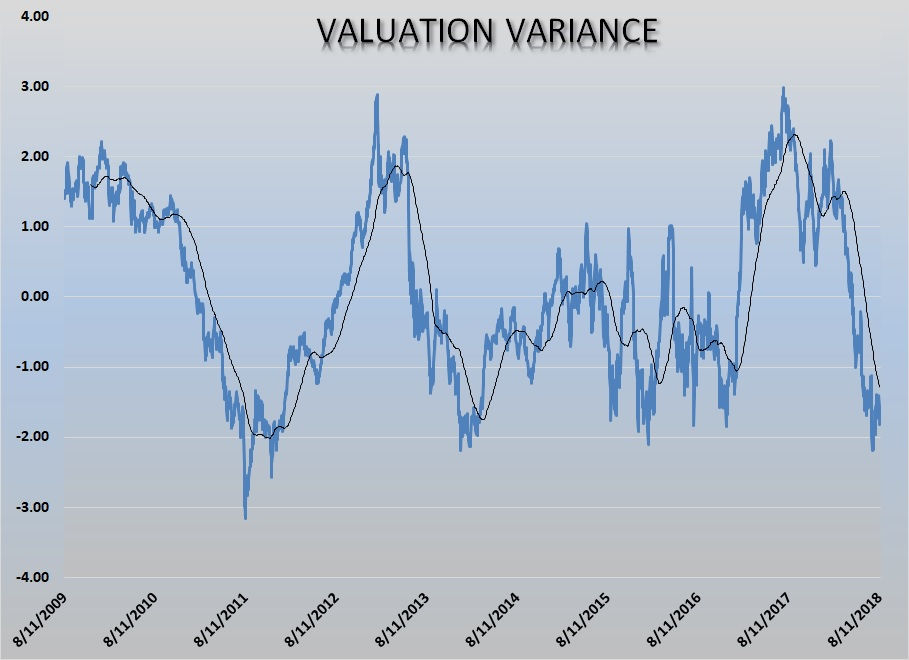
Looking at the history of the value variance readings for the Turkish model, we found similar scenarios in the past. On 7/25/11 the Turkish value variance z-score fell below two standard deviations from the mean. On 9/14/11, the value variance passed through the 75-day SMA that we use as a buy signal.

We are using the iShares MSCI Turkey ETF (TUR) as a way to gauge the potential returns. The ETF goes on the watch list on 7/25/11. The actual buy signal occurs on 9/14/11, the ETF was trading near $41.65. There was a continuation of the sell-off down to $33.97. After that washout, the ETF started to recover went on to rally over 60% in less than two years.

The second signal we received was on 1/29/14 when the value variance z-score fell below -2.0. The trigger buy signal occurred on 3/14/14 near $38.40 for the ETF.

Looking at the chart for TUR, the ETF went on to rally over 40% in the following five months.

The third signal we received was on 1/22/16 when the value variance z-score fell below -2.0. The trigger buy signal occurred on 2/23/16 near $34.30 for the ETF.

On the charts we find a 25% rally over the next three months.

Currency
There is a tight inverse correlation (-.60 correlation coefficient) between the USD/TRY relationship and the Turkish ETF.

Stabilization of the USD/TRY trade back down to it’s exponential trend line of 4 could add upside to the TUR trade. A move to 4 on the USD/TRY currency trade could add an additional $7 to $10 to the TUR upside move in our opinion.
While things look bleak right now, we have seen these types of events in the past. In 1994 Mexico suffered through their own currency crisis. In 1997 we had the “Asian Currency Crisis” that originated out of Thailand. That lead to the Russian bond and currency crisis in 1998. In 2001, Argentina went through their own debt and currency debacle. Each time there was an opportunity to capitalize.
Joseph S. Kalinowski, CFA
Comments