Check back soon
Once posts are published, you’ll see them here.


The Blue Wave
The market has started anticipating a “blue wave” this election season. According to the recent polling averages on Real Clear Politics, Democratic nominee Joe Biden is leading nationally by nearly eight points.

More concerning for Republicans is the polling averages in key swing states, that show Biden leading by an average of four points.

Additionally, the RCP average from the betting markets show Joe Biden has increasingly widened his lead over President Trump 64.4% to 36.3%.

If you go under the assumption that each candidate wins the state in which they are currently leading, this would result in a Joe Biden victory with 357 electoral votes to Donald Trump’s 181. Additionally, based on the current polling data, it appears the democrats are well positioned to flip the Senate 51 to 49 picking up four additional seats.
What This Means for the Stock Market
Assuming a blue wave, we would expect a bout of weakness in the stock market in the near-term as investors digest Democratic tax policies but ultimately believe this will be a catalyst for higher equity prices in 2021.
Capital Gains Tax – Year End Weakness
A Biden win could certainly drive equity prices lower into the end of the year as investors look to take profits prior to an increase in the capital gains tax. According to research from Goldman Sachs, the last capital gains tax increase in 2013 caused the wealthiest 1% of Americans to liquidate approximately $100 billion in equities in the three months leading up to the rate increase. That said, the S&P 500 finished up almost 30% in 2013 and was flat in 2014.
Goldman Sachs notes that they do not believe an increase in the capital gains tax will result in long-term price deterioration in equites or slowing economic growth, following the trend of 2013. They believe robust economic growth as we exit the COVID crisis will drive additional capital to the equity markets in 2021. Between corporate buy-backs, foreign investment, and investment from the top 1% of Americans, they have calculated that some $8 trillion in new investment will find its way into the capital markets driving equities higher.
Indeed, when we analyzed the correlation between the effective capital gains tax and the one, two, and three-year return of the S&P 500, we found a very low, positive correlation that debunks the theory that higher cap gains taxes has negative long-term impacts on equity prices.

Better Longer-Term Prospects
A blue wave would mean a prioritization of a fiscal stimulus bill which should be good for the economy and the stock market. Additionally, given the state of the pandemic, we may find the Dems punting tax reform until 2022, as raising taxes while so many are out of work isn’t smart policy. The uncertainty of a contested election (once the winner is determined) will also offer increased tail-wind for the market. We believe the stimulus bill from the Dems will ignite a sector rotation into cyclical, value, and COVID sensitive stocks to the detriment of high growth and technology. The impact of the stimulus bill will boost corporate earnings for those most affected by the pandemic further confirming our belief that growth stocks could underperform.
Don’t Count Out the Comeback Kid
After President Trump’s debate performance, which we consider a win for the Trump Campaign, there still lies the possibility of a Trump victory. Prior to the debate, Trump has a 38.2% chance of winning the election according to PredictIt and a 42.8% chance according to RCP.
Joe Biden is not leading by much more than Hillary Clinton was at this point in the previous election and Donald Trump was victorious. Clinton was leading by 3.9 points 11 days out while Biden leads by 7.9 points.
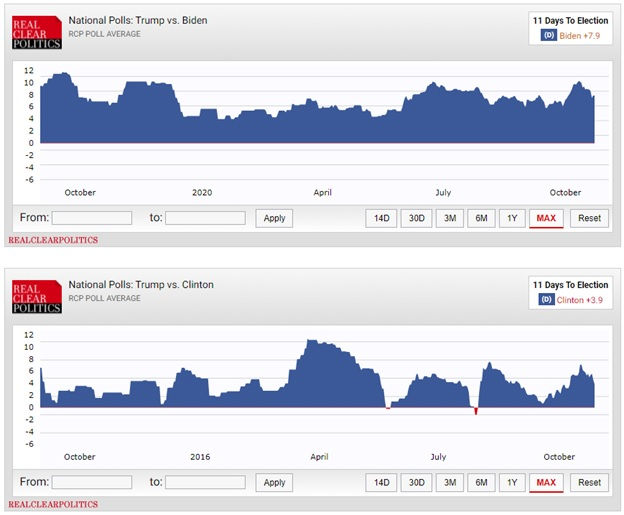
More importantly, in key swing states, Biden’s average lead over Trump is 4 points, marginally higher than Clinton that this point in the 2016 election.

The stock market hasn’t truly bought into the notion of a blue wave yet. With increased certainty of a Biden victory and the prospects of a reflation trade, one would expect to see value outperforming growth. Looking at the chart below one could see that is not the case.

A blue wave should also be putting pressure on managed care stocks, but looking at the managed care ETF, that is not the case at it is hitting new highs.

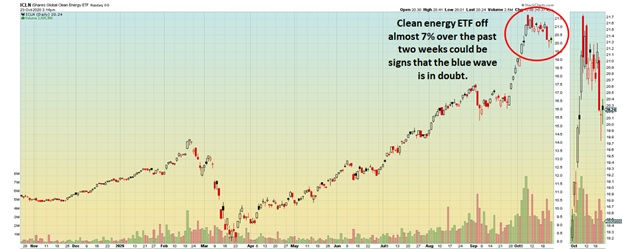
Clean energy stock ought to be on the rise if there is a blue wave, but that isn’t happening either.
Possible Outcomes
Deutsche Bank has constructed a probability matrix and potential scenario analysis for each of the possible outcomes.
1. "Blue Sweep" (60-70% probability) - "This result would provide the most fiscal stimulus to the economy in 2021. While the Biden plan does detail about $2.5tn of tax increases over the next decade, we assume these will not be implemented until the economy is on firmer footing, likely late 2021 or early 2022. Simulations of the Fed staff's model show that an additional $2tn stimulus package could significantly boost the economy next year, lifting real GDP growth by about 5 percentage points, adding 3 million jobs, and lowering the unemployment rate by nearly 2 percentage points," Deutsche Bank said.
2. "Biden win and Republican Senate" (20-25% probability) - "A Biden win and a Republican Senate - is also the most negative for 2021 growth, in our view. Fiscal stimulus is likely to be far more marginal and other key elements of the Biden agenda that could be implemented through executive orders or guidance on regulation are likely to be negative for near-term growth prospects. With control of the Senate possibly not determined until January, there could be a prolonged period of uncertainty about fiscal policy prospects following the election," Deutsche Bank said.
3. "Trump win and Republican Senate" (5-10% probability) - "In this scenario we assume that significant fiscal stimulus packages remain elusive, which results in a fiscal impulse of less than $500bn in 2021 ... On the trade front, we would expect a push towards implementing Phase 1 of the trade deal with China as well as stronger consideration of the key issues that were left out of the Phase 1 deal," Deutsche Bank said.
4. "Trump win and Democratic Senate" (0-5% probability) - "Our view is that this scenario would result in a stimulus deal roughly in line with the $2 trillion package currently being negotiated by House Speaker Pelosi and Treasury Secretary Mnuchin ... a Trump administration faced with Democrat control of the Senate and House could break from the Republican Senate's fiscal conservatism that has held back progress on recent fiscal stimulus talks. "Significant infrastructure spending is one potential area of agreement for a Trump White House and Democratic Congress, though only if the President is willing to rely heavily on public funding. Another area of agreement is a hard line on foreign trade and the economic relationship with China in particular," Deutsche Bank said.
Bottom Line
A contested election will certainly be a net negative for the stock market. Assuming all goes as the polls suggest and we do get a blue wave, we could see near-term pressure on the market that will be ultimately short-lived, in our opinion.
Contrary to the messaging set forth by the Trump Administration, we do not believe a Biden victory will lead to a market crash nor do we believe it will bring forth a depression. Given the fiscal stimulus that would come out of Washington, continued accommodation by the Federal Reserve, easing of trade tensions and the rebound in corporate earnings into 2021 and beyond, we anticipate the market will trade higher into next year.
Joseph S. Kalinowski, CFA
Comments